
Procrastinate Like It's 1989
By Matt

I still remember it vividly: after dinner one night, I pull out my homework folder, and my science assignment isn’t there. My school is long closed by now, so there’s no chance of me running over to get the worksheet I need.
Oh, and most importantly: this is the late 1980s—long before someone could just take a screen shot of the homework and email or text it over to me. The internet was still a decade away from being a fixture in my life.
So, what do I do? I lean on my mother to rescue me.
My mom gets on the landline and calls up Bobby McGuinness’s mom, who then proceeds to dictate the entire homework text over the phone while I just sit there, hanging my head in shame. My mom, an excellent stenographer by training, is taking down Mrs. McGuinness’s recitation in shorthand; I remember seeing only a few specialized science words (cytoplasm? plankton?) written out among the scribbles. Then mom hangs up the phone, and we sit down together to translate her notes into the full text, so that I can answer the comprehension questions and pass the assignment.
*
Sometimes art imitates life; and sometimes you find yourself watching a period piece that you actually lived through.
At the TriBeCA Film Festival last weekend, I had the great pleasure of attending the NYC premier of “Last Minute,” a short film by writer-director Michael Cusumano, who also happens to be my earliest friend (we grew up next door to one another). After being out of touch for over two decades, Mike and I recently re-connected after our mothers—who bowl in the same league in our central New Jersey hometown—discovered that we were living a few blocks away from each other in Queens.
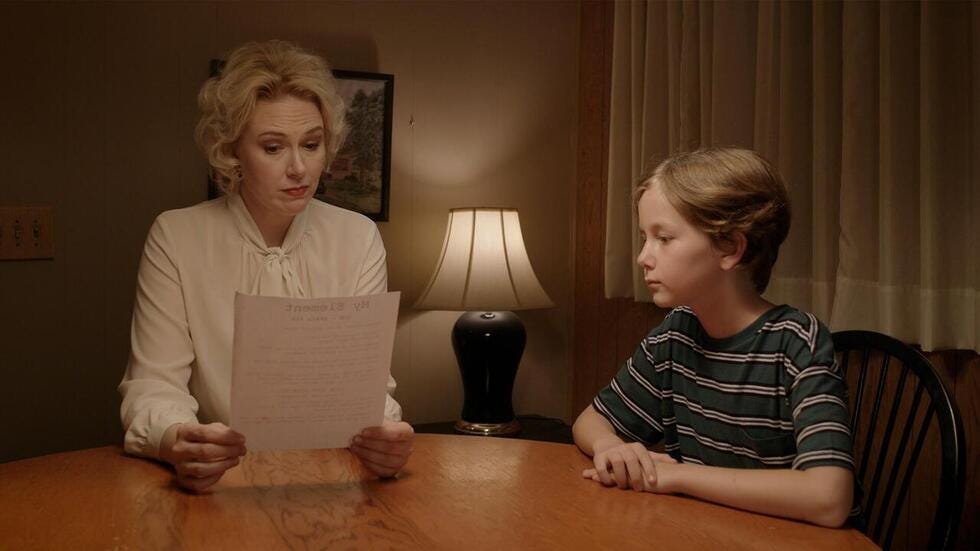
After setting the scene with some titles, rendered in fun 80s typeface—“The year is 1989. The internet is not in homes. ChatGPT is decades away…”—the 15-minute film launches straight into its main action. Twelve-year-old Jason (Espyn Doughty) has procrastinated mightily on his science project. As his hard-working single mom, Jackie (Charity Schubert), soon discovers to her great chagrin, he has done no work on it, it’s due the next day, and it constitutes a significant portion of his final grade. Whatever dreams for a relaxing evening of fast-food takeout, cheap wine and TV that Jackie might’ve had are now out the window. The bat signal has gone up, and it’s Mom to the rescue.
“Last Minute” is an utter delight—a charming and poignant story of the bond between a well-intentioned but lazy pre-teen boy and a mother who will do whatever it takes to help him succeed. But what I appreciated most about the film—and the reason I thought to write about it for this Substack—is its keen historical sensibility.
Nostalgic without becoming cloying, “Last Minute” uses its period setup as an occasion to interrogate what has been lost with the digital information revolution over the last three and a half decades. While Jackie and Jason might yearn for some “magic device” that would instantaneously give them the five original facts about plutonium that the assignment requires, what the film astutely offers up is a convincing portrait of how—in the pre-internet era—something as mundane as homework could mobilize one’s entire community. Over the course of one madcap evening—much of which Jackie spends sitting in her kitchen on the phone, just as my Mom had done when saving my ass with that call to Mrs. McGuinness—Jason and Jackie use every resource at their disposal to ascertain the needed information. It’s truly “all hands on deck,” as friends, neighbors, relatives, and even Jackie’s hapless occasional lover, Ken, all rally to the cause, contributing what they know. (Ken heroically comes through at the eleventh hour with the requisite visual aid).
As “Last Minute” reaches its triumphant denouement, Cusumano—like a seasoned cultural historian—has mounted a subtle argument about changing norms and the passage of time. The sequence of actions that Jackie and Jason take to solve their crisis are all shown to be perfectly natural given the constraints of the era. And while it’s certainly easier to have all the requisite information at one’s fingertips nowadays, the film suggests that perhaps there was something profoundly worthwhile about the collective problem-solving efforts that were often necessary in this bygone analog era. We might not yet have been connected to the information superhighway, with its infinitude and all its promise of speed and efficiency, but we were more connected to one another. As reviewer Peter Gray writes, “The inconvenience of the era becomes a catalyst for connection, forcing characters to rely on each other in ways that feel increasingly rare.”
It’s a theme I keep coming back to (including on this Substack): I wonder all the time about how we, like the frog in the slowly boiling pot, have unconsciously become inured to the ways our media and information environments have altered our patterns of communication—and, consequently, our capacity for human connection. Kudos to Mike and the team behind “Last Minute” for creating this fun, compelling, deeply humanistic slice of life, reminding us about the surprisingly ordinary ways that people used to show up for one another before our era of screen dominance, and how natural it once seemed to do so.
Love it. My mother always lamented I was a procrastinator. It was only when I got a low level job at a newspaper that I decided, no, I just do way better when I’m on deadline.