
Remember al-'Amiriyya
By Matt

As the United States blunders into another unnecessary—and unconstitutional—war in the Middle East, I’ve been thinking a lot about Iraq.
I’m sure I don’t need to remind many of our readers that the second Iraq War—President George W. Bush’s infamous war of choice—was a colossal mistake. What the neocon-laden Bush administration assumed would be a slam dunk victory for American-style democracy, turned into a messy and protracted conflict that saw Iraq plunge deep into political chaos for over a decade. As the American occupying forces struggled to fend off a scrappy and determined insurgency year after year, somewhere between 500,000 and 650,000 Iraqis ended up killed (with many more seriously injured). We now know that this war was pointless, based on an elaborate web of lies and fabrications, and that all those violent civilian deaths—to say nothing of ISIS’s rise and ensuing reign of terror throughout the region—were thus wholly avoidable. Though it is perhaps easy to forget, now that Bush and the recently departed Dick Cheney are routinely lionized in liberal media—somehow painted as the “good old Republicans of yesteryear” in comparison to the cabal of MAGA fanatics who run the country today—these men have serious blood on their hands.
But I’ve actually been thinking about the First Gulf War—the much shorter Iraq conflict that enjoyed universal support from the U.S.’s allies and was also genuinely popular at home. I was nine years old when this conflict erupted late in the summer of 1990; it is my first major political memory. I remember Wolf Blitzer’s impassioned reporting from Riyadh; like me, CNN came of political age with that war, too. I remember sitting with my family in our living room and watching on TV as the bombs fell over Baghdad—what seemed to me like a surreal laser light show, something you’d see at a Pink Floyd concert.
I also remember a surge of patriotism in the country. Tune into any radio station at the time and you were bound to hear “Tie A Yellow Ribbon Round the Ole Oak Tree,” an early-70s pop song about an ex-con freshly released from prison, wondering if his girlfriend would take him back, which had emerged as the unlikely anthem of national hope and solidarity during the Iran hostage crisis of 1979-81. (The 1981 Super Bowl, played a few days after the hostages were released, featured a giant yellow bow tied around the New Orleans Superdome). For whatever reason, this hokey tune was suddenly revived during the First Gulf War to inspire Americans to show their support for our brave troops selflessly toiling away in Operation Desert Storm. I remember bringing a yellow ribbon home from school and, lacking any oak trees in our yard, tying it around the basketball pole on our driveway.
Unlike the second Iraq War, which catalyzed vociferous protests around the country, even as the national Democratic Party and most liberal media caved to the Bush administration in the most craven way imaginable, there was scarcely any opposition to the First Gulf War. George H.W. Bush told us that this war was necessary to stop an evil dictator from swallowing up a vulnerable neighbor, and we bought it wholesale. “This aggression will not stand!” was the watchword, immortalized by the Dude in the Coen Brothers’ masterpiece, The Big Lebowski. The U.S. swiftly formed a coalition forty-two nations strong; that was proof enough for many of the righteousness of the cause. It seemed like a simple case of good v. evil; after all, the Cold War was on its last legs, and we were used to viewing the world in such Manichean terms.
Just last week, for my seminar “The Middle East and the Politics of Collective Memory,” I taught a section of Dina Rizk Khoury’s excellent monograph, Iraq in Wartime: Soldiering, Martyrdom, and Remembrance. I was particularly moved by Khoury’s account of the U.S. bombing of the al-‘Amiriyya shelter, an underground bunker in a crowded middle-class district of Baghdad, where over 400 Iraqi civilians were killed while seeking refuge from the Coalition Forces’ aerial assaults. At 4:30am on the morning of February 13, 1991, when most of the occupants (mostly women and children) were sleeping, two one-ton “smart bombs” were dropped on the shelter in quick succession. Those on the upper level of the complex were incinerated; those on the lower level were severely burned when the shelter’s water tank overheated and exploded.
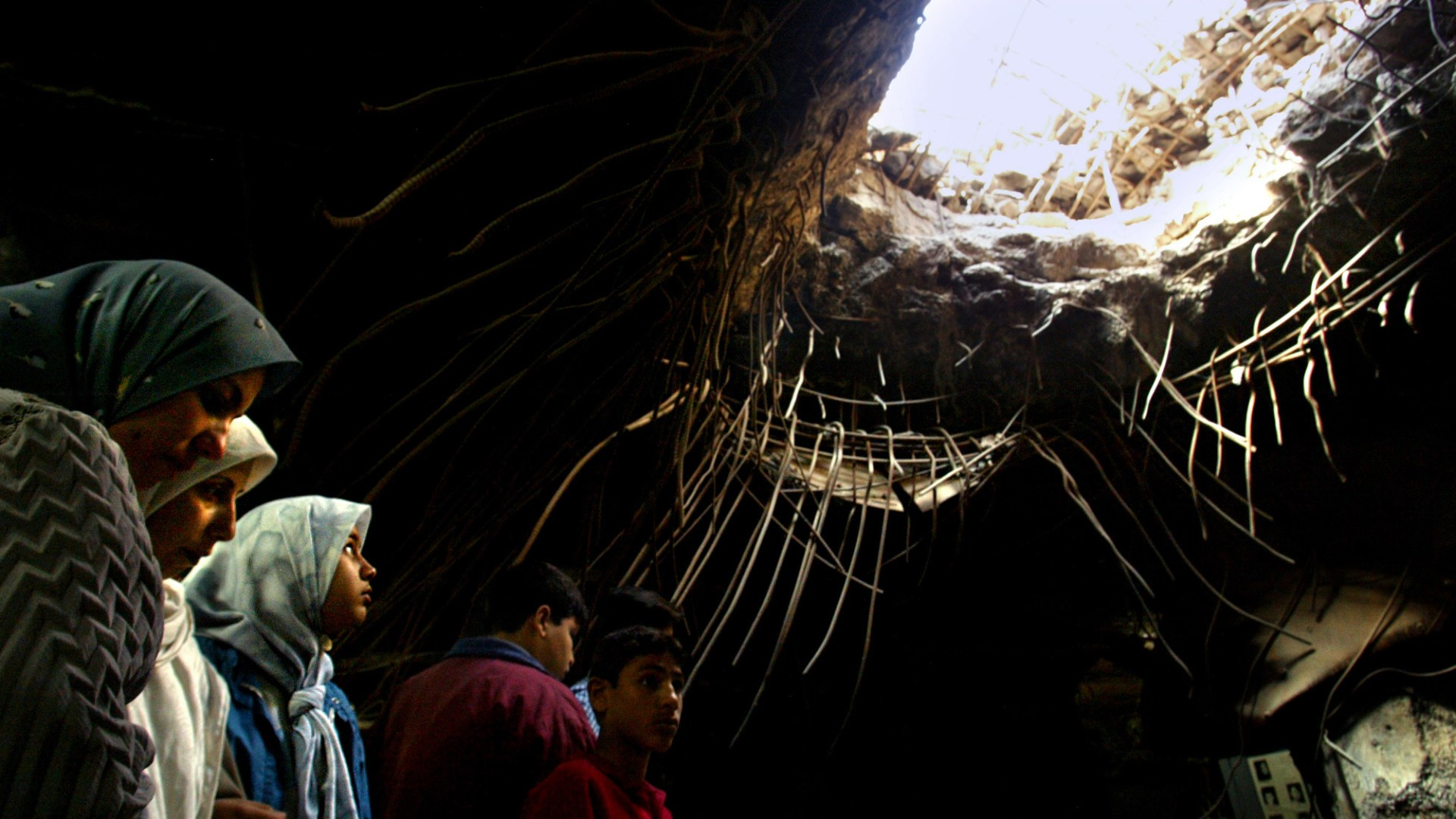
As Khoury explains, the al-‘Amiriyya bombing became a national site of memory and mourning for an already traumatized Iraqi populace. In the words of a blogger from Baghdad who went by the moniker Riverbend:
“For weeks and weeks the whole area stank of charred flesh and the air was thick with grey ash. The beige stucco houses were suddenly covered with black pieces of cloth scrolled with the names of dead ones. Ali Jabbar mourns the loss of his wife, daughter, and two sons….,’ ‘Muna Rahim mourns the loss of her mother, sisters, brothers and son.’… Within days, the streets were shut with the black cloth of tents set up by grief stricken families to receive mourners from all over Iraq who came to weep and ease some of the shock and horror.”
Picking up on the genuine groundswell of grief and public mourning in response to the al-‘Amiriyya massacre, the Iraqi government seized upon the opportunity to turn it into a state-sanctioned site of commemoration—a national memorial and mausoleum. As Khoury writes,
“The al-‘Amiriyya shelter left on exhibit the remains of the victims’ bodies and the detritus of their lives. It provided a venue for an on-site reenactment of those deaths by survivors…Located in a nondescript area, its very ordinariness served to highlight the precariousness of life and the injustice of the war against Iraq. Visitors, both Iraqi and foreign, were ushered into a building with an open gaping hole in the roof where the bombs had hit, which exposed the meshed reinforced steel. The blackened walls of the shelter were preserved, as were the ashes of those incinerated by the bombs. In the early years, visitors often commented on the stench of burnt bodies and the persistence of a haze of smoke within the shelter. The dried blood of victims provided visceral treatment to their violent deaths. On the first level, the outline of a woman holding her child as she burned remained seared onto the wall, while the lower floor’s ceiling had the imprints of palms of men and women trying to escape.”
The bombing of al-‘Amiriyya shelter was widely condemned as a war crime at the time—a claim affirmed by Human Rights Watch. But the U.S. military has consistently maintained that the shelter was being used as an Iraqi military command center, and that the blame for the massacre lay with Saddam Hussein, who cynically used civilians as human shields. The George W. Bush administration later doubled down on this interpretation in a report entitled Apparatus of Lies: Crafting Tragedy, published during the second Iraq quagmire, ostensibly to solidify its line that no Iraqi narrative could be trusted since it was all merely Saddam’s propaganda.
But this claim has been widely disputed, including by the U.S. Department of Defense as well as other members of the U.S. armed forces. Moreover, the first journalist on the scene after the bombing—Jeremy Bowen of the BBC—reported that he saw no evidence of military use in the bunker. The U.S. Department of Defense later stated that it knew al-‘Amiriyya had been used as a civilian shelter ever since the Iran-Iraq war (1980-88). To know its uses for civilian protection and commence with the brutal bombing, anyway, clearly constitutes a war crime.
Remember al-‘Amiriyya. Remember its defenseless victims when you follow the news from Iran. No matter how vile you might find a political regime, remember the plight of the innocent civilians who scramble to survive as their home is under brutal assault. Almost every war, if not all war, is unnecessary—the product of “shitty men,” as “Mother Russia” playwright Lauren Yee puts it, steering their countries in shitty directions. There is always a devastating human toll. There is always an al-‘Amiriyya—usually many of them; it doesn’t matter how good or “professional” a given military purports to be. There is no excuse for needlessly destroying the lives of people who never chose to live under an anti-democratic regime—one that happens to have made some extremely powerful enemies who have the audacity to decide, against the norms of international law, that they can take unilateral action to make it gone.
There will come a time for more granular political analysis of this war and its fallout. But for now, I needed to convey my unvarnished reaction to waking up on Saturday morning to news of this latest and most heinous of Trump’s overseas gambits. This war is wrong: deeply immoral and unconstitutional. Many civilians will die needlessly; already, after two days of bombing, at least 500 Iranians have been killed and around 750 injured. As I write this, the internet is erupting with reports of 153 dead at a girls’ elementary school in southern Iran. There will be many others just like it. Meanwhile, dozens more civilians have been killed in Israel and elsewhere in the region.
If you ever catch yourself wondering why the U.S. always seems to make so many enemies around the world, or why our rivals like Russia or China seem so emboldened to pursue their agendas of wanton expansion and aggression, I urge you to remember that the U.S.—certainly since Vietnam—has showed the world not simply that it will flout international law to pursue unnecessary and short-sighted wars of choice, no matter the cost, but that it has no compunction about piling up one civilian massacre after another.
Matt- you put into words what I have been thinking regarding our track record for involvement in foreign wars over the last three decades. And here we go again! And this time, there isn’t even an imminent threat.
Not to minimize how awful the regime has been in Iran, we did have a treaty with them that Trump abandoned during his first term. Plus, we were currently engaged in negotiations for a diplomatic resolution. I guess Trump wanted to leave his mark before the midterms. What a jerk!